How Does Modern Frontend Development Support Maintaining Consistency Across Pages?
A website can have a beautiful homepage and still feel broken when visitors move to the service pages, landing pages, blog pages, or contact page.
The problem is not always the design. Many times, the real issue starts during frontend development.
When every page is built separately without a shared structure, small differences begin to appear. Button sizes change. Spacing feels uneven. Fonts do not match. Cards behave differently. Mobile layouts become inconsistent. Over time, the website starts looking less professional, even if the original design file was clean and well-planned.
This is where modern frontend development plays an important role.
Modern frontend development is not only about converting a design into code. It is about creating a consistent, scalable, and maintainable frontend system that keeps every page aligned with the same design language.
For agencies, SaaS companies, marketing teams, and growing businesses, this consistency directly affects brand trust, user experience, conversion rates, and long-term website maintenance.
1. It Uses Reusable Components Instead of Rebuilding Every Section
One of the biggest reasons websites lose consistency is because developers build similar sections again and again from scratch.
For example, a website may have the same CTA section on the homepage, service page, and landing page. If each version is coded separately, small differences can easily happen. One CTA may have different padding. Another may use a different button style. Another may break on mobile.
Modern frontend development solves this through reusable components.
Common components include:
- Headers
- Footers
- CTA sections
- Hero sections
- Service cards
- Testimonial blocks
- Pricing cards
- FAQ sections
- Blog cards
- Forms
- Navigation menus
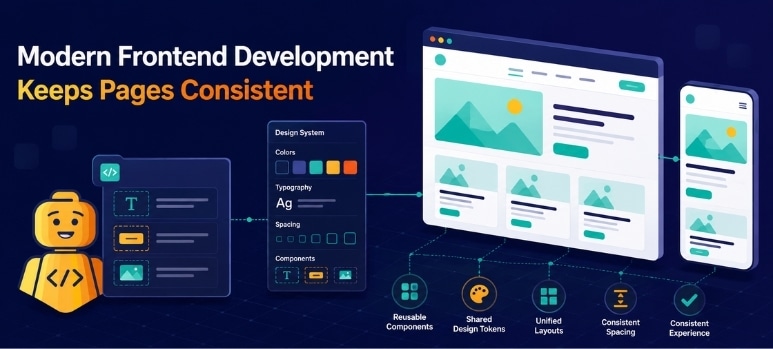
When these components are created once and reused across the website, every page follows the same structure. This keeps the design consistent and makes future updates easier.
For example, if your agency wants to update the CTA button style across the website, a component-based setup allows the change to reflect everywhere without editing each page manually.
That saves time, reduces errors, and protects brand consistency.
2. It Follows a Clear Design System
A design system is the foundation of visual consistency. It defines how typography, colors, spacing, buttons, icons, forms, grids, and UI elements should be used across the website.
Modern frontend development respects that system during implementation.
Instead of guessing font sizes or manually picking colors, developers follow predefined values from the design file. This helps maintain frontend development consistency across every page.
A strong frontend setup usually includes:
- Defined font sizes
- Consistent heading hierarchy
- Standard color variables
- Button styles
- Form styles
- Grid rules
- Spacing rules
- Border radius values
- Icon usage
- Layout patterns
When developers follow these standards, every page feels connected.
This is especially important for brands with multiple landing pages, service pages, location pages, case studies, or CMS-driven content. Without a frontend system, each new page can slowly drift away from the original design.
3. It Keeps Typography Consistent Across the Website
Typography has a major impact on how professional a website feels. Even small differences in font size, line height, heading weight, or paragraph spacing can make pages feel disconnected.
Modern frontend development handles typography with a structured approach.
Developers define reusable typography styles for:
- H1 headings
- H2 headings
- H3 headings
- Body text
- Small text
- Labels
- Buttons
- Navigation items
- Captions
- Blog content
This ensures that all pages follow the same reading experience.
For example, your homepage H2, service page H2, and blog section H2 should not all look different unless the design system clearly requires it.
Consistent typography improves readability, strengthens visual hierarchy, and helps users move through the website without confusion.
4. It Maintains Uniform Spacing and Layout Structure
Spacing is one of the most common reasons websites feel inconsistent after development.
A design may have perfect spacing in Figma, but if the development team does not follow the layout carefully, the live website can look uneven.
Modern frontend development uses spacing systems to avoid this problem.
This includes consistent spacing for:
- Section padding
- Card gaps
- Column spacing
- Button margins
- Text spacing
- Image spacing
- Form fields
- Mobile section gaps
Consistent spacing makes the website feel clean and balanced.
For business websites, this is not just a design issue. Poor spacing affects readability, user flow, and conversion. If a page feels cluttered or uneven, visitors may lose trust before they even read the offer.
A well-developed frontend keeps every page visually aligned, whether the page has five sections or fifteen.
5. It Makes Responsive Design More Predictable
A website may look consistent on desktop but fall apart on mobile. This usually happens when responsive behavior is not planned properly.
Modern frontend development treats responsiveness as a core part of the build, not as a final adjustment.
Developers plan how each component should behave across:
- Desktop
- Laptop
- Tablet
- Mobile landscape
- Mobile portrait
This means the same card, CTA, menu, or content section behaves consistently across different pages and devices.
For example, service cards should not stack one way on one page and another way on a different page unless there is a clear design reason.
Modern responsive development ensures:
- Text remains readable
- Buttons stay usable
- Images scale properly
- Sections stack logically
- Navigation works smoothly
- Forms remain easy to complete
- No unwanted horizontal scrolling appears
This is especially important for businesses that depend on mobile leads. A consistent mobile experience can directly improve inquiry rates and reduce drop-offs.
6. It Reduces Design Drift Over Time
Many websites look good at launch but become inconsistent after a few months.
Why?
Because new pages are added. New campaign landing pages are created. Blog templates are updated. CTAs are changed. Teams make quick edits. Over time, the website starts drifting away from the original design.
Modern frontend development reduces this problem by creating a strong foundation from the beginning.
When pages are built with reusable components, global styles, and structured layouts, it becomes harder for future updates to break the design.
This is useful for:
- Digital agencies managing multiple client websites
- SaaS companies adding feature pages
- Marketing teams launching campaigns
- Businesses adding location pages
- eCommerce brands expanding product categories
- Webflow and WordPress websites using CMS templates
A scalable frontend structure protects the website from becoming messy as it grows.
7. It Keeps Buttons and CTAs Consistent
Buttons are small elements, but they play a big role in conversions.
If your CTAs look different across pages, users may not clearly understand where to click. One page may use a rounded button. Another may use a square button. One may have a hover effect. Another may not. One may be highly visible. Another may blend into the page.
Modern frontend development creates standard CTA styles that remain consistent across the website.
This includes:
- Primary buttons
- Secondary buttons
- Text links
- Icon buttons
- Form submit buttons
- Sticky CTAs
- Mobile CTAs
When CTA styles are consistent, users recognize actions faster. This improves usability and supports better lead generation.
For service-based websites, CTA consistency is especially important because every page should guide visitors toward inquiry, consultation, quote request, or contact.
8. It Supports Consistent CMS and Template Pages
Many modern websites use CMS templates for blogs, case studies, resources, locations, team profiles, or portfolio pages.
If these templates are not developed properly, each content page can look different.
Modern frontend development creates structured templates so dynamic pages remain consistent, even when non-technical teams add new content.
For example, a case study template may include:
- Hero section
- Client overview
- Challenge section
- Solution section
- Results section
- Testimonial section
- CTA section
Once the template is built correctly, every new case study follows the same layout.
This helps marketing teams publish faster while keeping the website professional and brand-aligned.
For platforms like WordPress, Webflow, HubSpot CMS, and Shopify, this structure is essential for long-term scalability.
9. It Improves Collaboration Between Designers and Developers
Frontend consistency depends on smooth collaboration between design and development teams.
Modern frontend development encourages developers to understand the design file properly before writing code. They review components, spacing, breakpoints, typography, layout rules, and interaction states.
This avoids common issues like:
- Ignored mobile frames
- Incorrect font weights
- Mismatched spacing
- Wrong hover states
- Broken section alignment
- Inconsistent card sizes
- Missing design details
When developers work closely with the design system, the final website looks closer to the approved design.
This is especially valuable for agencies that need white-label frontend development support. Their client expects the final website to match the approved design, not a rough version of it.
10. It Makes Website Maintenance Easier
Consistency is not only about launch quality. It also affects future maintenance.
If every page is built differently, even a small change can take too much time. Updating a button, changing a font, adjusting a CTA section, or improving a layout may require editing many pages manually.
Modern frontend development makes maintenance easier by using shared styles and reusable structures.
This means businesses can:
- Update pages faster
- Add new sections easily
- Maintain brand consistency
- Reduce development errors
- Lower long-term maintenance effort
- Scale the website without rebuilding everything
For growing companies, this becomes a major advantage. The website can evolve without becoming difficult to manage.
11. It Helps Improve User Trust
Visitors may not always notice perfect consistency, but they quickly notice when something feels wrong.
If every page looks different, users may feel that the website is outdated, unorganized, or unreliable. This can affect how they judge the business.
Consistent frontend development helps create a smoother brand experience.
When pages follow the same design language, users feel more confident moving through the website. They understand where to find information, how to compare services, and where to take action.
For B2B websites, this trust matters even more. A prospect may visit your homepage, service page, pricing section, case studies, and contact page before submitting an inquiry. Every page needs to reinforce the same level of professionalism.
12. It Supports Better Conversion Paths
A consistent frontend structure helps users move from awareness to action.
When page layouts, CTAs, content sections, and visual hierarchy are consistent, visitors do not need to relearn the website on every page. They can focus on the message and the offer.
This improves conversion paths for:
- Service inquiries
- Quote requests
- Demo bookings
- Consultation calls
- Contact form submissions
- Newsletter signups
- Resource downloads
For marketing and sales teams, this is where frontend development becomes more than a technical task. It becomes part of the conversion strategy.
A well-developed website does not only look good. It helps users move smoothly toward becoming a lead.
13. It Creates a Scalable Foundation for Agencies
Web agencies often manage multiple websites, landing pages, or client campaigns. They need frontend development that is not only accurate but also scalable.
Modern frontend development helps agencies deliver consistent results across projects by using repeatable processes, reusable components, and structured QA.
This is useful when agencies need:
- Figma to HTML conversion
- Figma to Webflow development
- Figma to WordPress development
- PSD to HTML conversion
- XD to HTML conversion
- Landing page development
- White-label frontend support
- Ongoing website maintenance
Instead of rebuilding everything from scratch, agencies can rely on a structured frontend approach that protects quality and speeds up delivery.
Why Consistency Matters for Business Websites
Consistency across pages is not just a visual preference. It affects business performance.
A consistent website can help improve:
- Brand trust
- User experience
- Mobile usability
- Lead generation
- Content scalability
- SEO structure
- Page maintenance
- Development speed
- Client satisfaction
For agencies and businesses, this means fewer design issues, fewer revision cycles, better user journeys, and stronger website performance after launch.
When the frontend is built properly, every page feels like part of the same brand.
How Pixel Perfect HTML Helps
Pixel Perfect HTML helps businesses and agencies convert designs into clean, responsive, and consistent frontend websites.
Our team focuses on accurate design implementation, reusable structures, responsive layouts, clean code, and quality testing so your live website matches the approved design and works smoothly across devices.
We support:
- Figma to HTML
- Figma to Webflow
- Figma to WordPress
- XD to HTML
- PSD to HTML
- Custom frontend development
- White-label frontend development
- Website maintenance
Whether you are launching a new website, building client pages, or scaling an existing digital presence, a consistent frontend foundation can save time, reduce rework, and improve user experience.
Conclusion
Modern frontend development supports consistency across pages by using reusable components, design systems, global styles, responsive rules, CMS templates, structured QA, and scalable coding practices.
This consistency helps websites look professional, work smoothly, and remain easier to maintain as they grow.
For businesses, it creates a better user experience. For agencies, it improves delivery quality and reduces revision time. For marketing teams, it supports stronger conversion paths.
If your website design is ready but you want the live version to stay consistent across every page and device, working with an experienced frontend development partner can make all the difference.
Need help converting your design into a clean, responsive, and consistent website? Pixel Perfect HTML can help you turn your Figma, XD, or PSD files into production-ready frontend code.
About the Author